Sunday, June 8, 2014

Michael Clifford: We’ve become indifferent to dead babies


The Tuam babies story this week says much about the past, but about the present also.
The graveyard in the grounds of the former so-called mother-and-baby home was first discovered by two 12-year-old boys, in 1975. One of them opened the concrete cover and was met with the horror below. Pretty quickly, the cover was drawn across again. In the 1970s, the past had not yet been acknowledged. Indeed, the past wasn’t even past.
The next major juncture in the story was last October, by which time local historian, Catherine Corless, had painstakingly compiled and matched records from the home. Corless concluded that the concrete tank must contain most, if not all, of the nearly 800 infants who had died in the home during its existence, between 1925 and 1961.
The story was first published in the Connaught Tribune on October 10 last, which reported that the number of babies allegedly involved was 788. Continuing research has brought this number up to 796.
Declan Tierney’s report in the Tribune began: “Research has shown that there are 788 children, from newborns to eight-year-olds, buried in a graveyard that was attached to an old orphanage in Tuam.
“And a group of interested individuals have now established the names of each of the children, what age they were when they died, and the causes of their deaths. It is now their intention to erect a memorial in their honour and this will contain the names of each of the 788 children.”
Tierney’s report stated that Tuam Town Council had been approached about funds.
That’s eight months ago. There was precious little reaction to the story. It made no waves.
The mainstream media did not pick up on it. In the dark past, such an oversight might have been attributed to a reluctance to upset the powers that were, such as the Church.
Does anybody really believe that the mainstream media today would ignore such a story on the basis of subservience? But the mainstream media is not the gatekeeper it once was. Social media often drives the agenda these days, but there was little take-up in cyberspace. And what about the tribunes of the people — politicians? Some of the most passionate comment about the story has emanated from Galway politicians, such as Colm Keaveney, Ciaran Cannon and Lorraine Higgins.
Politicians in this country pay far more attention to local than to national media.
Is it plausible that none of them, nor their staff nor close supporters, read the local paper back in October?
Then there’s the Bishop of Tuam, Michael Neary. Last week, he issued a statement on the matter. “I was greatly shocked, as we all were, to learn of the extent of the numbers of children buried in the graveyard in Tuam. I was made aware of the magnitude of this situation by media reporting and historical research.”
When did the bishop’s shock take hold?
Did nobody point out to him the news that was published in the local paper last October?
We move on to May 25, just a fortnight ago. The Mail On Sunday gave the story the full shock treatment. The paper had the added detail that the burial ground was actually a septic tank. That detail strikes a primal chord. The notion of throwing the bodies of society’s most vulnerable into a pit designed for waste spoke volumes for the times that were. Yet, the substantive issue was the same as it had been the previous October.
There was still little take-up. The news, over the following days, was dominated by the results of the local and European elections, not to mention the presence, among us, of Kim and Kanye.
The story only began to gain traction when the world outside looked in.
By last Wednesday, the mass grave, with its resonances of massacres and war zones, was making headlines in CNN, the major American newspapers, Al Jazeera, and as far away as Australia.
On Wednesday, on RTÉ’s News at One, Aine Lawlor introduced it as a story that was getting attention abroad. By that afternoon, the focus had shifted. It was as if the world outside had awoken the media here, and all other organs of state and society, to the horror that had been uncovered: ‘Wake up, Ireland! You have another scandal on your hands’. In the media, there is a condition known as ‘being too close to the story’. Reporters suffering from this tend to lose focus, and even objectivity, on the big picture, because of an extended period working in close contact with the parties involved.
Perhaps wider society has also got too close to the story of the brutality of the past. For the last two decades, the dark past has been tumbling out in all its horror.
Industrial schools, Magdalene laundries, symphysiotomy, clerical sex abuse, the wronged, the discarded, the punished, all the marginalised victims of a totalitarian society whose public morality was subcontracted out to the Catholic Church which, in turn, was obsessed with sex.
Is it possible that the drip, drip of these scandals has left the national psyche jaded, or even exhausted, by the emotional toll of acknowledging the long procession of the wronged?
Either that, or maybe many among us had believed that all of the scandals had already been aired, if not properly dealt with.
Then, along comes another. It says a lot that it took the glare of the outside world, and the primal detail of infants discarded in a septic tank, to awaken national outrage.
Now, establishing the facts should be the primary focus. The remains in the tank may account for some, all, or none of the infants who died at such a frightening rate during the 36-year existence of that home. A proper inquiry must establish how life was lived and how it died, not just in Tuam, but in the other so-called mother-and-baby homes in the State.
More high walls must be knocked down. How, for example, could a home run by religious, rather than dedicated medical personnel, have ever been regarded as a suitable place for the birth and nurturing of new life?
Is it any wonder that the mortality rate was so much higher in these institutions? After all, the State was asking the nuns not to nurture and care, but to hide from public view the results of what society at large regarded as the wages of sin.
Any inquiry must resist an impulse to focus primarily on blame.
The nuns’ regime may have been harsh, or even brutal, but it was tacitly approved by wider society. Those infants, whose lives were regarded as second-class, and their mothers, deserve no less than to have history properly recorded, even at this late stage of the excavation of the past.
Michael Clifford

Barry Clifford: Fillius Nullius: The Child Of No Man

There is nothing more nauseating than having a priest in the winter of his years trying to vie for the title of a populist one, otherwise caricatured as Fr. Trendy, in trying to airbrush his past. In this case even his real name helps to permeate the myth that somehow he was different than the rest: Fr Good. He ran one of the quasi-adoption agencies for the Catholic Church in England in the 1950's for young mothers –to be, fleeing from Ireland and its regard for them and their unborn child from a fate that was a living death. The Catholic Clergy created that terror which ran like a plague through every town and hamlet in Ireland. It was the inquisition of the modern age in an Island apart that still embraced the dark ages.  

I believe that at the very least Fr. Good was indifferent and downright culpable in the illegal adoptions of Irish children in England. The byword by his fellow clergy for these ‘adoptions’ was ‘Pregnant From Ireland.’ The devil though is in the detail of his words as he remembered his past fondly in Ireland’s Sunday Independent today, seen of course through his rose tinted glasses. He has to, for under the norms and beliefs of his religion then hell is surely around the corner waiting for someone who looks remarkably like him.

“Get rid of the baby, that was the main idea.” He tells without remotely acknowledging his quilt in the apparatus of getting rid of the babies in his charge: 954 to be exact. He then tells us we have no concept of the shame of those days, a shame fostered by the Catholic Church Clergy, of which he is still a member, alone, which drove some of its financial engines using the fuel of a superstitious craven Government and its citizens.  

I became enlightened to know by him in the article that a child whose father was unknown was classed as Filius Nullius: The child of no man. 

“Things are only coming to light now” he says, yet Fr Good has known about it when in much younger clothes and in a position to have actually done something too. He probably started his coin and stamp collection at that time and taken too much with the importance of it all. We are also told in the article that Fr Trendy was some kind of radical in 1968 when he opposed the anti- contraception stance of his beloved Church. That makes him one of ours I suppose: a hero of the working classes or any class; and he might have had a drink or a smoke too. Radical stuff for sure.

Yet, he was the terrifying figure of the man in black waiting for the young mothers to-be at the Fishguard port in Wales. He was the only alternative to them being put into a Magdalene Laundry or an Industrial institution, or to be ostracized by the village of idiots who outnumbered the one on his own. At some point in his ramblings he tries to blame the Irish Government alone that they covered up the adoptions in the 1950’s, and that the real number was 9000 babies rather than the 1500 admitted by them.

You can bet safely that it was much higher than that again for the Catholic Church has proven to be quite adept at figures or missing files by earth, fire and water. The child/mothers who came to him underscored an even more bigger crime than the forced adoptions in Ireland and in England: the crime of rape and incest against children, for those that came to this man in black were children themselves ranging from 12 to 18 years old.

Only 9 babies of the 954 were returned to their mothers by Fr Trendy, which proved he was very good at this particular job: the task of separating mother from baby. As I suggest the devil is in the detail.

When asked about the notorious Bessborough mother and baby home in Cork Fr Trendy showed his true colours even more: “We knew nothing about it at all. We kept away away from Bessborough. We didn’t want to be linked up with them as they were local babies. And we were fairly sure the nuns weren’t obeying the adoption laws. Various things about the signing of consent. We kept our distance.” 

In the end of the interview when asked about the abortion problems of today, Fr. Trendy concluded: “I suppose it goes back to the age old question: ‘What is morality all about?’

I know for sure Fr Trendy/Good will never want to find that out because the truth will terrify him, for to find out that you were the bad guy all along believing that you were the good guy can be the most terrifying just before the bell tolls.


Barry Clifford            

Friday, June 6, 2014

Barry Clifford: How Do Good People Turn Bad?


                                                                 Nazis On Parade


How do good people turn bad and some even stay that way? That is if they are good people to begin with for it needs weakness to help the decay and maybe that overrides what good really is about; Knowing the difference between right and might makes the former an easy bed partner to the mind and is life to the soul; the latter is an appeasement to a lesser God and a more dangerous corrupt ideology. Rarer still, is that a good strong person rarely goes bad for within their supports is individuality though it may not mean that they are good either. That is what I believe in general describes the variables at work when we want to use the analogy of the Nazi regime and the Catholic clergy that sets about their work of murder either in a concentration camp or from the apparatus of an inquisition; or what separates a Catholic nun from throwing an infant into a septic tank full of hundreds more babies, and we can only hope they were dead when they went into it; or what makes any person wearing any uniform succumb to the gravest of crimes. Indeed Nazi or Catholics do not have a monopoly on extremism yet all are in uniform of some sort that succumb to the mob mentality. All it needs then is a little bit more stoking.
  
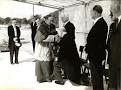
                 The Former Prime Minister And President Of Ireland kissing the A Bishops Ring 

And to allow any of it to exist at all needs a certain token support, even if albeit a reluctant one, along with the belief that they are untouchable and forever un-accountable. When these conditions exist we will have crimes of the worst kind, and that to look at it with moral outrage can only mean that a person was living on a remote island alone without any knowledge or co- existence of any other since they were born.

Recent history alone has proven all of these things to a reasoned person though the defenders of these crimes will tell us it was a different time and circumstance. But time is indifferent to these events, and circumstance does not change in any great measure the variables at work already mentioned. In microcosm you see it in the workplace and all too often in the family home everyday, or waiting in a line like a beggar and allow yourself to be humiliated to get an underpaid job just to keep your head above water so you can feed your child.

Yes, a bad economy helps, a no-way out mindset does too, but the tie that binds is the security of the mob that empowers the weak, the feeble minded and  the downright ugly. Without that support they become a fragile water bug that requires no effort to kill it. The mob in Ireland’s case was a Government theocracy that married religion with politics and wrote it into a constitution. Hitler’s reign was little different in it’s design. It’s execution had many similarities that included concentration camps, and only in Ireland did that mean you had to be a Catholic and a child: 160,000 children alone over a 35 year period in a country that never topped three and a half million people.


The Magdalene Children Prisoners At Work

The Germans were suppose to have been a cultured and en-lightened people since the renaissance and Ireland bragged that they were the Island of scholars for a thousand more and yet nothing could stop their return to the dark ages for almost the entire time of the 20th century. It could be argued that Germany is at pains still regarding it’s past and was best explained, by a now very different point of view, given by a former German soldier that was once part of the mob from that 2nd World war: “The American’s can say that they were fighting for freedom, the British theirs. What can we say we were fighting for.” 


It is in stark contrast to a nun from her mob that is one of Ireland’s wealthiest  religious orders who said recently about the Magdalene laundries/prisons that they ran for profit: “It was part of the system and the culture of the time.” 

Barry Clifford

Thursday, June 5, 2014

Stories of survival should not be hidden in 'shame'

It was wrong to give a guarantee of anonymity to both victims and abuser
IT IS exactly five years since the Ryan report into the residential institutional abuse of children was published. When he presented his report, Mr Justice Sean Ryan said categorically that the State authorities had been systematically and continuously "submissive and deferential" to the religious orders which ran the hellholes that were industrial schools (and also the Magdalene laundries, although they were not included in the scope of the report).
When his commission of enquiry had originally been set up, it had been headed by Ms Justice Mary Laffoy; she resigned in despair because she found herself faced with a brick wall in attempting to get co-operation from the religious orders involved.
Judge Ryan stuck with it; and he gave us a report which proved in the face of every attempt at denial and justification, that children were denied their rights, denied an education, physically abused, frequently sexually abused, half-starved, and terrorised. Thirty five-thousand children were committed to industrial schools over the years.
When the Ryan report was published, Brother Kevin Mullan, the head of the Christian Brothers in Ireland, one of the orders indicted, said he and his people would continue to co-operate with "those seeking to explore" what had happened. But the exploration would not include the naming of the individual members of the order who were responsible for the inhumanity. The Irish State had, after all, guaranteed them protection and anonymity.
A few months after publication of the Ryan report, Judge Yvonne Murphy presented the report of her enquiry into the sexual abuse of children in the Archdiocese of Dublin. Its findings, let us remember, were equally damning. The then Vatican Ambassador to Ireland, Monsignor Giuseppe Leanza said in reaction that communications between the Irish Government and the Vatican would be "improved" to avoid "misunderstandings".
What he described as misunderstandings had been the deliberate attempt to prevent Ms Justice Murphy gaining access to files in the Vatican archives which contained documentary proof of the abuse.
But the evidence came out despite church obfuscation, denial, and obstruction. It came out in no small part thanks to the men and women, the dispossessed who had been abused, often to the point of emotionally and mentally destroyed lives, who found the courage to tell their stories in face of the awesome power of the Roman Catholic Church, the monolith that had been buttressed for generations by the Irish State.
And many of them later went on to give evidence to the Residential Institutions Redress Board, an indignity in itself: their suffering had been proved, but the State was still prepared to subject them to a further ordeal which seemed to many of them to be an attempt to minimise the monetary compensation to which they were morally entitled.
In return for their courage, the State guaranteed that the documents which contained their testimony would be destroyed. It was to be their "protection", giving them some kind of empowerment over their personal dignity.
The guarantee of anonymity applied alike to victims and perpetrators. But neither guarantee should have been given, in the interests both of justice and of compassion. The guilty men and women of the religious orders did not deserve to escape their shame, for whatever reason: "the culture of the time" or any other spurious excuse. Nor should they have been immune from prosecution where their behaviour merited it, regardless of old age or infirmity.
Equally, and for entirely different reasons, the victims of abuse should not have been assured by the State that their documentary testaments would be destroyed. The assurance was akin to the legal custom of not revealing in court the identity of a rape victim: but a victim has nothing to be ashamed of.
The abuse victims whose sad stories formed the evidence for the Ryan report had learned to keep their stories secret: they had been well-trained in the industrial schools which stole their youth, and often their innocence. They had lived their lives believing they were worthless, their childhoods something to be ashamed of, bewildered and bereft. When they summoned up the courage to have their stories heard, they should have been helped to realise that they had nothing to be ashamed of, and that the only people shamed by their experiences were the religious authorities and indeed, the State authorities who had allowed themselves to be browbeaten into complacency by the prevailing Catholic culture.
The victims should have been given the opportunity and encouragement to understand that they could be proud of their stories and their will to survive.
But not having taken the trouble to help the victims to come to terms with that simple premise, the State assured them that what they had lived with as their "shame" would remain a secret. They were assured when they gave testimony to the Ryan Commission and to the Redress Board that more than two million documents which had been the basis for both reports would be destroyed.
And now the Government has agreed in principle that the Minister for Education Ruairi Quinn may bring forward amending legislation to retain the documentation instead of destroying it. It is to be deposited in the National Archive, and sealed for at least 75 years, with access after that to be subject to very "strict safeguards".
Not merely is that a betrayal of a solemn promise to the victims, it is also pointless. In my opinion, the only reason to retain the documents would be for them to remain as a scar on our national consciousness, available at all times to remind us of our inhumanity as a society. It is a reminder that should hang over us, rather than having it concealed until the generation which colluded in the guilt is long dead.

The victims should have demanded, and should have been encouraged, to name themselves in pride. That they weren't was a betrayal. And this latest move is a double betrayal.
Emer O' Kelly

Photo Minute: Namibia; take time to listen to the silence of the soul


Photo Minute: Insects Like You May Never Have Seen Them Before


Wednesday, June 4, 2014

Barry Clifford: Throw The Wee Things Into The Ould Septic Tank

Sr Theresa looked up at the Mother Superior for a bit of direction. “Ah, sure another bastard child died last night. What will I do?”
“That’s the one from the illegitimate whore I expect.” Mother Superior replied dryly.
“ What will I do with the bag of bones that’s left?”
“ That is left Sr Theresa.” Mother Superior corrected as proper diction was one of her strong points. “Throw the wee thing into the ould septic tank.”

Sr Theresa hated the job. It was the air you see and even once she peered inside. She would never look there again, throwing the skeleton bodies in with shut eye thereafter.

The rancid smell of the other 700 and more infants decaying and decayed bodies was heaven within, for many battalions of insects with their families had set up permanent camp in the tank. There was the larger feeders about: rats, cats, and foxes that found their way here by that sweet scent of death. Some of them did not make it out of the tank either for gluttony killed a few here and there, while many more robust rats bred within the hollow stomach walls of the dead children. It was survival of the fittest as the only reward for second prize was death.  

Sr Theresa busied herself for someone had to do the job and knew she was doing God’s work. She knew too other infants did not die quick enough in this place over the years work for starvation can be a slow process, so the other nuns and her improvised. Drowning was quick, a pillow quicker, and throwing them over stairwells was the quickest of them all. But she was irked a bit recently for it was said the sound of crying was coming from the septic tank, babies crying.
And the talk of it was growing.

So one night she waited to find out for herself. She crept tip-toe from the convent hall to the tank without telling anyone. The wind picked up as she waited in the darkness under a tree. Then the rains came. She craned her neck, pricked her ears until her whole body was a satellite dish wired for sound. Then she heard it and sounded as clear as her conscience. She heard it again and could formulate at last the words: “Mama, Mama.” Her heart missed a beat.

Then she saw it: Two cats in mating frenzy; one wanting and the other not. She threw a stone at them and another as they scurried in full retreat. She fell back relived. That was all it had been she thought. She turned to go back. By the first step she heard the crying again and this time it was louder. One part of her told her to run and the other was a promise to herself that this must not happen again.

She was not a superstitious nun and talk of ghosts was irrational which drove her forward to open the septic tank. In the almost total darkness inside it looked like everything moved. A heaving mass of pulsating animals feeding and gorging only on death and within its vortex the sound of crying started again. Its plaintive tone grew, it’s pain with it. The panic started with the throbbing of her temple and then Sr Theresa felt something gnawing at her foot. A large rat was not for letting go for the frenzy of his hunger did not part the living from the dead. Her eyes widened in terror but the utter horror was yet to come as the wind howled around her lifting her from the mantle of the septic tank to drop her within the grey and dark liquid of decay and bone. Her black habit dragged her down and the last thing she ever saw before she hit the bottom of the pit was…………..                 
  

By Barry Clifford

In memory of the 796 infants whose bodies were found in a septic tank in a Mother’s and babies home for profit run by the Bon Secours nuns in Tuam Co Galway. Many of the mothers of the children were buried on the grounds of this prison that closed in 1961. They were classed as whores and their children as bastards, and all this murder was done under a quasi- legal pact between Church and State that were inseparable even within its constitution.

May they rest in peace.